
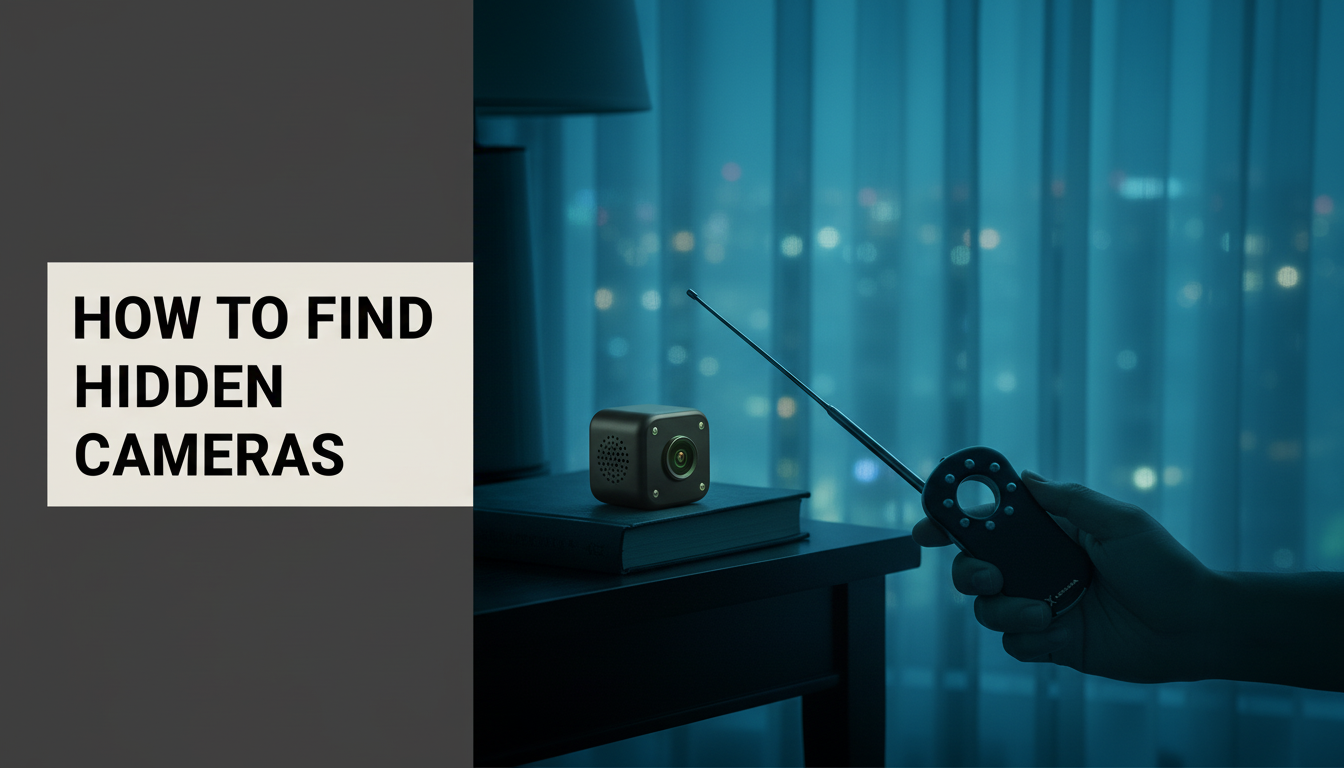
Hidden cameras in short-term rentals and hotel rooms are rare but not hypothetical, and the equipment involved has become small and cheap enough that a careful check is worth ten minutes on arrival. This is a practical method, in the order that finds things fastest.
1. Look at what faces the bed and the bathroom door
Start with sight lines rather than objects. Stand where you would undress and look back at everything with a clear view of that spot. Covert cameras need an unobstructed angle, which massively narrows where they can be. Anything on that line is worth a closer look; anything facing a wall is not.
2. Check the objects that plausibly hold electronics
A camera needs power and concealment, so it tends to live inside things that already have a reason to be plugged in or to sit at eye level:
- Smoke detectors and air purifiers, especially ones pointed at the bed rather than mounted centrally on the ceiling
- Alarm clocks, phone chargers, USB plugs and power banks
- TV set-top boxes, streaming sticks and speaker units
- Decorative items at bed height — picture frames, fake plants, tissue-box holders, wall hooks
- Air vents and anything with an existing small hole
A lens needs an aperture. Look for a hole roughly 1–3mm across, often with a faint glassy or purple sheen under direct light.
3. Turn off the lights and use your phone torch
Darken the room, then sweep slowly with a bright torch held close to your eye line, looking for a small bright reflection. Camera lenses retroreflect — they send light back towards its source — so a lens will glint distinctly compared with a screw head or a bit of plastic. Move slowly; the reflection is only visible within a narrow angle.
4. Look for infrared with a front-facing phone camera
Most night-vision cameras illuminate with infrared LEDs that are invisible to the eye. Many front-facing phone cameras lack the IR filter that rear cameras have, so in a fully dark room they can show IR LEDs as faint purple-white dots. Open the selfie camera and pan slowly around the room.
This test has real limits. It only works while the camera is actively illuminating, and it will not detect 940nm infrared at all, which is specifically chosen to be invisible. A negative result here is weak evidence.
5. Check the network — with the same caveat
Network scanning apps list devices on the WiFi you are connected to, and an unexpected camera-like device is a genuine signal. But a covert camera may record to a local SD card with no network connection at all, or run its own hotspot rather than joining the house network. Again, finding nothing here does not mean much.
6. Use an RF detector for the cases the above miss
The gaps in the manual methods are consistent: cameras that are not transmitting when you look, and infrared you cannot see. A radio-frequency detector closes part of that gap by picking up the transmissions a wireless camera makes, and a lens-detection mode uses the same retroreflection principle as the torch trick but with a calibrated light source and viewing filter, which is far more reliable than doing it by eye.
The Lexuma XSCAN is a pocket detector that combines both: an RF sweep for active transmitters and an optical lens finder for cameras that are only recording locally. It is not a guarantee — nothing is — but it covers the two failure modes that a manual search struggles with most.
If you find one
Do not dismantle or unplug it. Photograph it in place, including its position in the room, then contact local police and the platform or hotel management. In most jurisdictions covert recording in a rented private space is a criminal offence, and preserving the device as it was found matters for any investigation. Leave the room if you are able to.
A note on the other side of this
If you are installing cameras in your own property, the same law applies to you. Monitoring entrances, shared living areas and the outside of your home is generally lawful. Bedrooms and bathrooms used by guests are not, and many countries require you to disclose recording to anyone staying. Our mini security camera buying guide covers where cameras are appropriate to place.